Choosing a waste monitoring system is not a technical formality. It is a decision that directly affects operating costs, ESG reporting accuracy, and regulatory compliance, year after year.
The smart waste management market is growing from $2.95 billion in 2025 to a projected $3.38 billion in 2026, driven by the rise of intelligent waste analytics platforms and data-driven route optimization. The category is expanding fast, which means more vendors, more claims, and more noise.
This guide cuts through it. Below are the seven criteria that actually matter when evaluating a waste monitoring system, whether you manage an office campus, an industrial site, or a multi-location operation.
Real-Time Data, Not Periodic Snapshots
The first question to ask any vendor is simple: when does data become available?
Many systems still operate on scheduled uploads, daily, weekly, or worse, manual. This creates blind spots. If a bin overflows on Tuesday and the data arrives Friday, the operational value is zero.
A proper waste monitoring system captures and transmits data continuously. Data should flow to a central dashboard enabling real-time visualisation, alerts, and route planning, not just end-of-period reports.
Look for: live dashboards, threshold alerts, and timestamped events at the collection or bin level.
AI-Powered Waste Recognition, Not Just Fill-Level Sensors
Fill-level sensors tell you how much waste there is. AI tells you what kind — and that distinction is what unlocks recycling improvement.
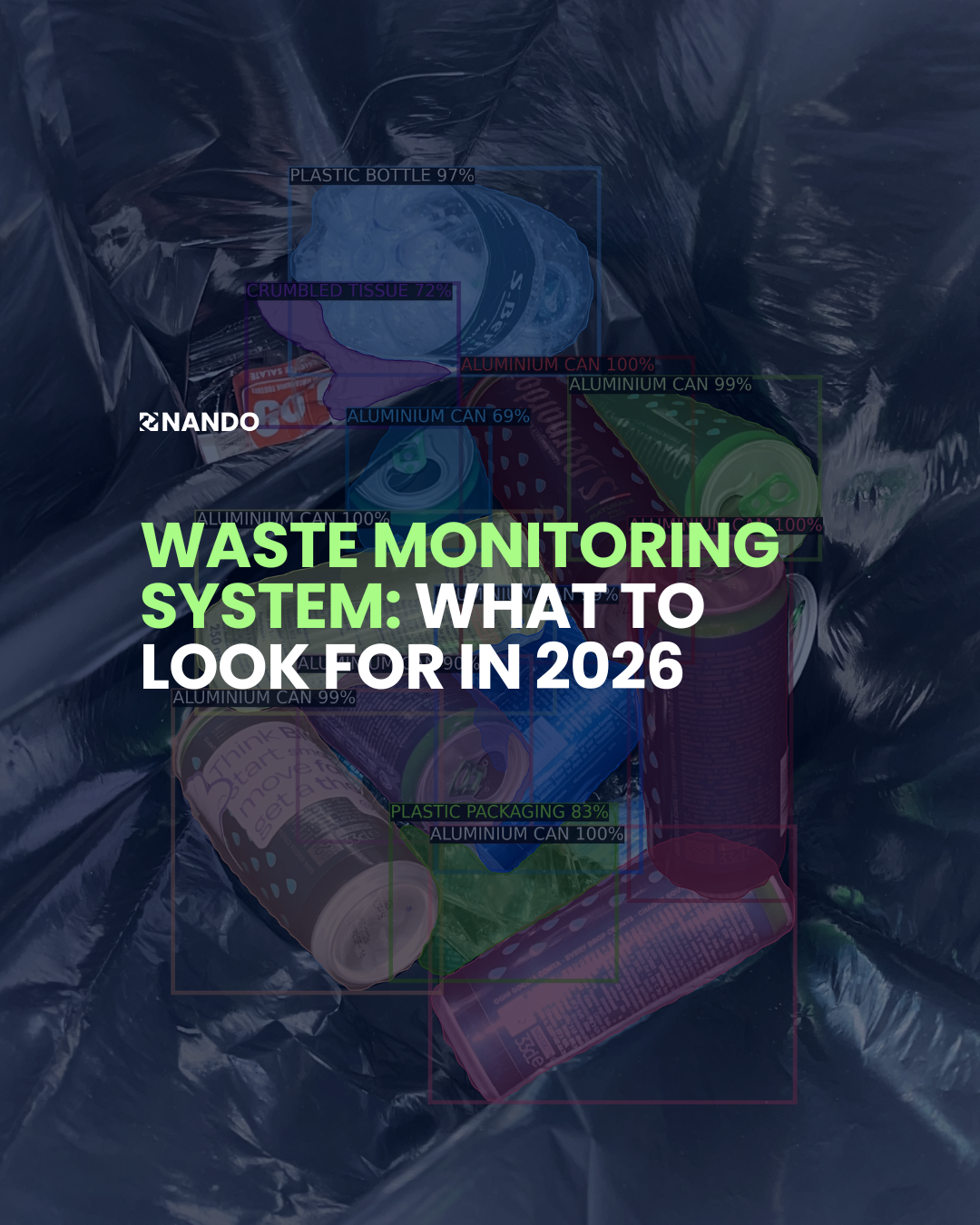
Computer vision and machine learning algorithms can classify waste by stream (plastic, paper, organic, mixed) in real time, directly at the point of generation. This is the difference between knowing “bin A is 80% full” and knowing “bin A is 80% full, 60% of which is recyclable material currently going to landfill.”
Machine learning systems for waste recognition can distinguish material types, plastics, glass, paper, metals, with accuracy above 95%.
For ESG reporting and recycling rate improvement, waste stream composition data is far more actionable than volume alone.
Coverage Across All Waste Streams and Locations
Siloed monitoring creates siloed data. A system that covers only office bins while ignoring the canteen, loading dock, or industrial floor gives you a partial picture that cannot support either operational decisions or sustainability reporting.
Evaluate whether the solution works across:
- Office and workplace environments
- Food service and canteen operations
- Industrial and manufacturing settings
- Urban or multi-site collection points
Over 61% of waste firms have integrated AI-based route optimization, and 48% have adopted sensor-based waste segregation globally, but unified, cross-environment coverage remains the key differentiator between basic tools and enterprise-grade platforms.
Automated Reporting for ESG and Regulatory Compliance
Manual reporting is one of the most costly and error-prone activities in waste management. Sustainability managers spend hours compiling data from spreadsheets, weighbridge receipts, and contractor invoices, data that is often incomplete, inconsistent, and unverifiable.
A serious waste monitoring system eliminates this bottleneck. It should automatically generate structured reports aligned with major frameworks: GRI, ISO 14001, LEED, and sector-specific requirements.
Detailed reporting is essential for compliance and sustainability, modern systems should deliver data insights on waste volumes, types, and treatment outcomes, enabling businesses to track progress against environmental goals.
Ask vendors specifically: can the system produce audit-ready data? Who certifies it?
Privacy-by-Design Architecture
Waste monitoring in offices and public spaces involves cameras. This immediately raises GDPR and privacy compliance questions that many vendors address only vaguely.
The standard you should require is automatic, irreversible anonymisation, faces and licence plates blurred at the device level, before any data leaves the premises. Only already-anonymised images should be transmitted.
This is not optional. It is a legal requirement across the EU and an increasing expectation in enterprise procurement. Any vendor that cannot demonstrate a documented privacy-by-design process should be disqualified.
Independence from Client Infrastructure
Waste monitoring should not require IT integration projects to get started. Systems that depend on client Wi-Fi, internal servers, or VPN access create implementation delays, security review cycles, and ongoing maintenance risk.
The better architecture is full operational independence: the monitoring hardware uses a dedicated, secure connection and does not require access to any internal systems. This means faster deployment, lower IT burden, and no dependency risk.
Ask the vendor directly: does your system require access to our network or internal infrastructure?
API Integration for Data Centralisation
Once waste data is captured and verified, it needs to flow into the broader operational and sustainability stack — BI platforms, ERP systems, ESG reporting tools.
A waste monitoring system without API integration becomes an island. The data lives in a proprietary dashboard that never connects to the organisation’s actual decision-making processes.
IoT waste technologies that integrate data analytics tools enable real-time monitoring and data-driven decision-making across the entire waste management ecosystem. Verify that the API is documented, stable, and actively maintained, not a theoretical capability that requires custom development to use.
The Real Question: Monitoring or Measurement?
Most legacy waste management tools track logistics, truck routes, collection frequencies, contractor invoices. What a modern waste monitoring system does is fundamentally different: it measures what actually happens to waste, at the source, in real time, with certified data.
That shift, from logistical tracking to operational measurement, is what enables recycling rate improvement, cost reduction, and credible ESG reporting.
NANDO is built on exactly this architecture. Computer vision and machine learning algorithms developed specifically for waste, deployed across offices, industrial sites, canteens and urban collection, with automated reporting, full GDPR compliance, and API integration.
Curious about the numbers? Use the NANDO Cost Saving Calculator to estimate your potential savings in under 2 minutes.