Digital Waste Tracking: why manual scales cost you more
Manual waste weighing with a mechanical scale is still the most common method for collecting data on waste generated in commercial, industrial, and service buildings. It is a consolidated process, familiar to operators, and seemingly reliable.
The problem is that the data it produces is less reliable than it appears, and the operational cost required to obtain it is much higher than typically calculated.
In 2026, this limitation has become harder to ignore. Companies face at least three concrete pressures that require accurate, digital, and auditable waste data:
- ESG reporting obligations (CSRD): Large European companies must produce transparent and verifiable data for sustainability reporting, including waste data and Scope 3 emissions.
- ISO 14001 and EMAS: Companies certified under ISO 14001 or registered under EMAS must monitor and measure their environmental impacts, including waste generation, with data that can be verified by external auditors. Manual, non-calibrated measurement does not meet the reliability requirements of these standards.
- Circular economy and corporate sustainability strategies: Achieving zero-waste targets or waste reduction goals requires high-granularity data on waste composition, not just total weight. Without knowing what is being discarded and where, it is impossible to define an effective strategy.
An analog scale produces a number. Today’s regulations require data.
The Traditional Process: Four Steps, Four Points of Error
The standard measurement flow using a mechanical scale consists of four stages:
- Manual weighing of the bag on the scale
- Manual recording of the weight on paper or in a digital register
- Data entry into Excel
- Sharing the report with the manager
Each step introduces a margin of error. None of the four produces disaggregated data by waste type. And the entire process requires operational time that is rarely accounted for in the real cost of waste management.
The real issue is not weighing — it is tracking. The manual process creates a lack of real-time alerts, no visibility into contamination, and no ability to forecast future volumes. The data exists only at the moment it is written down and then disappears into Excel until the monthly report.
Most Common Types of Mechanical Scales
Several types are available on the market, with different features and tolerances:
- Spring scale (±5–10% tolerance)
- Bench scale for light waste
- Industrial waste scale (capacity up to 500 kg)
- Cart-integrated collection scale
- Dedicated scale for canteens and retail (GDO)
All share the same structural limitation: they produce a total weight, without information about waste composition or quality.
The Accuracy Problem: Why 78% Is the Real Figure
A new, calibrated mechanical scale has a standard tolerance of ±0.1 kg (OIML R111 standard). On a 4 kg bag — the average size in commercial or industrial contexts — this corresponds to an initial 3% loss in accuracy, which may seem acceptable.
The problem emerges over time and in real operating conditions:
ISO 9001 calibration. The ISO 9001 standard requires certified annual calibration. Without it, tolerance can increase to ±0.5 kg after only six months of continuous use, reducing accuracy by approximately 9%.
Human error. Incorrect bag placement, double counting, misreading, distraction — these factors cause variations of up to ±10% in real operating conditions.
Adding these factors together:
| Accuracy Reduction Factor | Mechanical Scale | NANDO.App |
|---|---|---|
| Standard tolerance | -3% | -5% |
| Missing ISO 9001 calibration | -9% | ISO 9001 certified ✓ |
| Human errors | -10% | 0 |
| Real final accuracy | ~78% | ~95% |
A non-calibrated scale used under real conditions averages 78% accuracy. NANDO.App, by eliminating human error and ensuring ISO 9001 Bureau Veritas certification, reaches 95%.
The difference is concrete: on a site producing 100 kg of waste per day, 78% accuracy means 22 kg of incorrect data every day — approximately 8,000 kg per year of measurements on which operational, reporting, and sustainability decisions are based.
How NANDO.App Works: A Photo Instead of a Scale
The operator installs NANDO.App on the smartphone they already use. The process is reduced to two steps:
- Take a photo of the bag contents before replacing it
- Automatic AI-generated report on the centralized dashboard
Main system features:
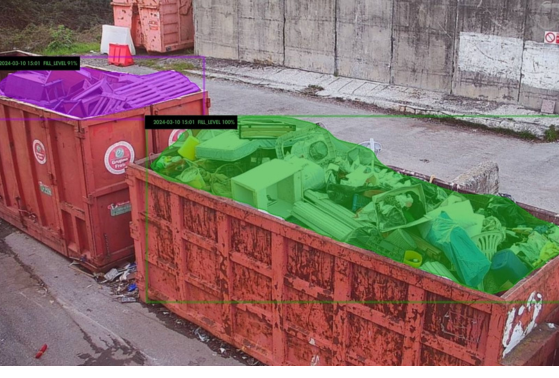
- Object recognition: AI identifies what is thrown away, category by category
- Weight-volume association: advanced algorithms correlate visible volume with estimated weight
- Contaminant detection: the system identifies misplaced materials that reduce recycling quality and increase disposal costs
- Real-time dashboard: data available per bin, floor, building, or multi-site network
- Certified ESG reporting: auditable data compatible with CSRD, RENTRI, MUD, and major international frameworks
No scale. No paper logs. No connection to the site’s private network: the app runs autonomously on 4G.
The Hidden Cost of Manual Weighing
The comparison is not only about accuracy. The operational cost of manual weighing is systematically underestimated.
Data collected from real NANDO installations with 300 bins shows:
| Measurement Activity | Without NANDO.App | With NANDO.App |
|---|---|---|
| Time per bag | 1 minute | 6 seconds |
| Total daily time | 5 hours/day | 0.5 hours/day |
| Labor cost (30$/h) | $54,000/year | $5,400/year |
| Net savings | — | $48,600/year (85%) |
The 85% savings in labor cost dedicated to waste measurement emerges from comparing one minute per bag with a mechanical scale versus six seconds with NANDO.App — translating into tens of thousands of dollars per year for sites with medium waste volumes.
Accuracy That Improves, Not Degrades
A structural difference compared to mechanical scales: NANDO.App’s accuracy does not degrade over time — it improves.
Each photo feeds a dynamic database updated in real time through generative AI. The more the system is used in a specific context, the more precise it becomes for that environment.
Internal data shows that in the first 12 weeks accuracy increases progressively from an initial 60% to 92%, where it then stabilizes. A non-calibrated mechanical scale follows the opposite trajectory.
The Data a Scale Cannot Provide: Waste Composition
Even under optimal conditions — perfectly calibrated scale, no operator error — a fundamental limitation remains: total weight does not reveal waste composition.
A weighed bag returns a number. It does not say whether the waste is paper, plastic, organic, or mixed. It does not identify contaminants. It does not allow calculation of recycling quality.
By classifying bag contents through AI, NANDO.App produces disaggregated data by material type, enabling analyses impossible with mechanical weighing: segregation quality, contaminant identification, collection optimization by stream, ESG and CSRD Scope 3 category reporting.
Which System Should You Choose?
The answer depends on the operational context and regulatory obligations.
Manual weighing with a mechanical scale remains sufficient for very small waste volumes, no ESG reporting requirements, and no need for category-level data. In all other cases, the structural limitations of the system — degrading accuracy, non-auditable data, high operational cost — become a concrete problem.
NANDO.App is the appropriate choice for organizations managing multiple sites, subject to CSRD or RENTRI obligations, aiming to optimize recycling with real data, or needing to reduce operational time dedicated to measurement. Digitalizing waste measurement is no longer optional for those who must transform waste weight into actionable business intelligence.
Replace the scale with a photo.
Discover how NANDO.App can reduce manual measurement costs and provide finally reliable waste data.
Book a free demoFrequently Asked Questions
For spot measurements or an initial baseline, manual weighing still makes sense. Its limitations emerge when used as the sole continuous monitoring system: degrading accuracy, aggregated non-auditable data, and high operational cost compared to informational value.
No. The workflow is reduced to taking a photo of the bag before replacing it. No manual registration, no technical expertise, no access to site IT systems is required.
Initial accuracy ranges between 60–70% and increases over the first 8–12 weeks, reaching 92–95% as the AI model learns the specific operational context. After 12 weeks, accuracy stabilizes.
Yes. The platform produces ISO 9001 Bureau Veritas certified, continuous, and auditable data compatible with CSRD Scope 3 reporting and major international sustainability frameworks (BREEAM, LEED, EMAS, ISO 14001).
© 2026 NANDO. Tutti i diritti riservati.