The problem with “per lift” pricing
Most businesses pay for waste collection the same way they always have: a fixed price per bin lift, agreed upfront, charged the same whether the bin is full to the brim or barely a quarter full.
It’s simple. It’s predictable. And it’s fundamentally broken.
Commercial waste is still, for the most part, charged by volume, even though one of the big cost drivers for dealing with residual waste is its weight. If you’re charging the same price for a heavy bin containing lots of food waste as for a light one, you’re making one customer subsidise the other.
The result is a system that rewards no one. High-waste businesses pay the same as low-waste ones. Operators have no financial reason to help clients reduce. And councils and contractors fly blind, collecting without any real data on what they’re actually picking up.
Why 2026 is a turning point
Two things have collided this year to make the status quo harder to defend.
The first is regulatory. From October 2026, waste receiving facilities in the UK will be legally required to record waste movements digitally, replacing paper-based documentation with real-time tracking from production to final treatment or disposal. That means data is coming, whether operators are ready or not.
The second is cost. As of 2026, landfill tax stands at £98.60 per tonne at the standard rate, and collection costs for general commercial waste range from £10 to £30 per bin lift. With fuel prices still elevated and disposal costs rising, the margin for inefficiency is shrinking fast.
Flat-rate billing made sense when waste was cheap and data was hard to collect. Neither of those things is true anymore.
What non-domestic PAYT actually means in practice
Pay-as-you-throw for commercial users isn’t a new concept — waste management companies have led the way in implementing PAYT schemes where the weight or volume of individual residual waste bins is recorded and used to determine the charge to businesses. What’s changed is the technology available to do it at scale, without expensive infrastructure.
For non-domestic users — shops, offices, restaurants, schools, logistics sites, a volume-based model typically works like this:
- A fixed base fee covers the service regardless of usage (vehicle availability, scheduling, administration)
- A variable component is calculated on actual volume collected per lift, per waste stream
- Users who produce less, or separate better, pay less
- Contamination events can be logged and flagged, not just absorbed into the cost
The incentive structure becomes visible. And when the incentive is visible, behaviour changes.
The data problem (and how to solve it)
The main reason PAYT hasn’t scaled faster in commercial waste is simple: you can’t bill by volume if you can’t measure it.
Traditional collection vehicles have no mechanism for capturing what they pick up per customer, per lift, per stream. Drivers note stops completed, not volumes collected. Back-office billing runs on contracted frequencies, not actual data. And any attempt to retrofit measurement, manual weighing, paper logs, adds cost and error without adding intelligence.
This is exactly the gap that NANDO.Sentinel is built to close.
NANDO.Sentinel mounts AI cameras directly on collection vehicles. As each bin or container is emptied into the hopper, the system captures volume data in real time, per lift, per location, per waste type. No manual input. No retrofitted weighbridges. No change to the collection vehicle itself beyond a 3–4 hour installation.
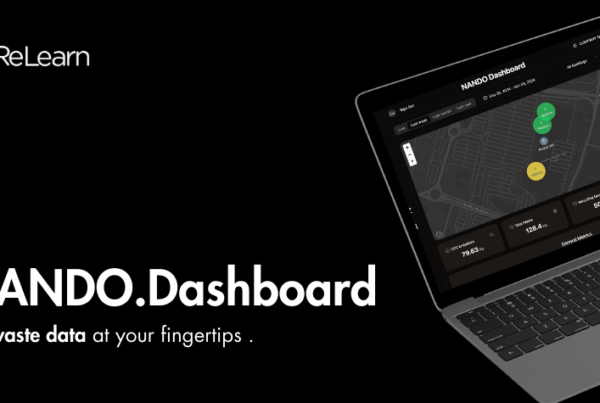
The result is a continuous, geolocated record of exactly how much waste was collected, from whom, and when. That dataset is the foundation everything else is built on: variable billing, route optimisation, contamination tracking, and reporting.
What this means for operators and councils
For waste management operators, volume data per lift unlocks the ability to offer genuinely differentiated pricing — rewarding commercial clients who segregate well and produce less residual waste, while fairly reflecting the real cost of servicing high-volume accounts. It also makes the case for contract renewal much stronger: you’re not just offering a collection service, you’re offering verified sustainability data.
For local councils running commercial collection services, PAYT charges must fully compensate for the cost of service provision — and flat-rate models increasingly fail to do this when disposal costs are volatile. Volume-based billing makes the service financially sustainable and defensible.
For non-domestic users — the businesses on the receiving end — the conversation shifts. Instead of a fixed cost they can’t influence, waste becomes a variable they can manage. Reduce residual volume. Improve segregation. Pay less. The logic is straightforward; it just requires the data infrastructure to back it.
The Simpler Recycling angle
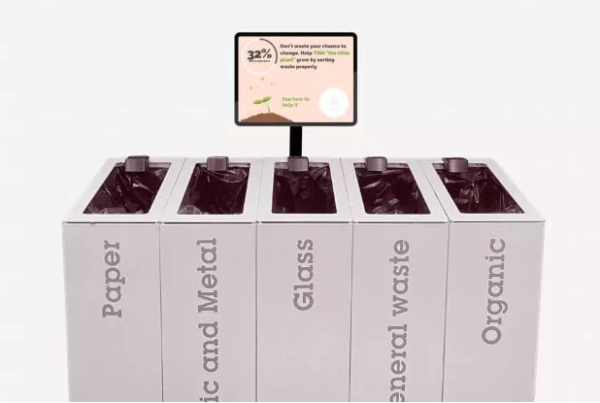
The timing matters. Simpler Recycling regulations in England require larger businesses to separate dry recyclables, food waste, and general waste — a reform that is actively reshaping how waste is collected and material flows are managed across the sector.
Separation at source is now mandatory for most non-domestic premises. But separation without measurement is half the job. Knowing that a business has separated waste tells you nothing about whether they’ve done it well, how much they’re producing across each stream, or whether contamination is undermining the value of what’s being collected.
Volume detection at the point of collection fills that gap, turning a compliance requirement into a measurable, billable, reportable data stream.
The bottom line
Volume-based billing for commercial waste isn’t a future trend. It’s a logical response to three things happening at once: rising disposal costs, new digital tracking requirements, and separation mandates that only make sense if someone is measuring what’s actually being separated.
The barrier has never been the business model. It’s been the data. NANDO.Sentinel removes that barrier, directly on the vehicle, in real time, at scale.
If you run collections for non-domestic clients and you’re still billing by lift alone, the question isn’t whether to move to volume-based charging. It’s how long you can afford not to.
Book a demo
See how NANDO turns every collection run into a billing-ready data stream.
Book a Free Demo