
Facilities can automate industrial waste stream monitoring by combining AI-powered cameras, IoT fill-level sensors, and a centralized data platform. These industrial waste stream monitoring systems classify waste types in real time classify waste types in real time, track container fill levels across all collection points, generate compliance documentation automatically, and alert operations teams before overflows or contamination events occur, with no manual data entry.
This is no longer a niche capability. In 2026, manufacturers are transitioning from manual reporting to autonomous sustainability systems, driven by tightening ESG disclosure requirements and the operational costs of getting waste management wrong.
Here is how it works in practice, and what to look for when evaluating solutions.
Why manual waste tracking fails at industrial scale
In a manufacturing plant, waste is generated across dozens of collection points simultaneously — production lines, chemical storage areas, packaging stations, maintenance bays, canteens. Each stream may fall under a different regulatory classification, require separate documentation, and carry different disposal costs.
Manual tracking in this environment has three structural failure modes.
The first is latency. A container that overflows at 2pm on a Tuesday creates a safety incident and a production disruption, but the data only surfaces in the next weekly report. By then, the cost has already been paid.
The second is inaccuracy. Manual volume estimates and weight calculations are unreliable. Inaccurate waste quantity tracking causes logistics inefficiencies, incorrect invoicing, and failed audits, all of which compound over time across multi-site operations.
The third is fragmentation. Multi-site industrial groups face overlapping regulations with conflicting reporting formats. Without a centralised system, compliance becomes a manual reconciliation exercise that consumes significant staff time and still produces unverifiable data.
The four components of industrial waste stream monitoring
AI-powered waste recognition cameras
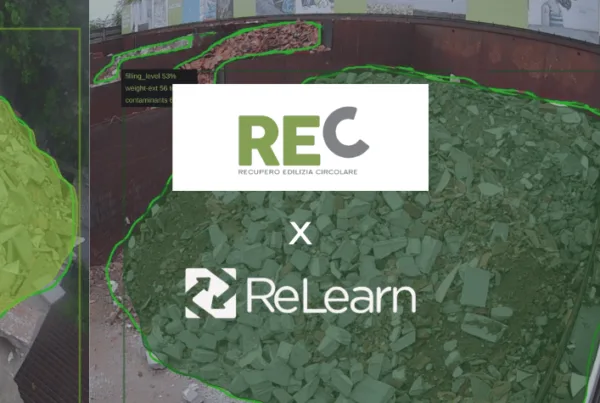
Computer vision cameras installed at collection points classify waste by type, plastic, metal, paper, organic, hazardous, in real time, directly at the point of generation. This replaces manual sorting verification and catches contamination before it reaches treatment facilities.
AI identifies waste types and materials in each container, ensuring proper handling, treatment routing, and regulatory classification.
This matters because misclassified industrial waste has direct consequences: rejected loads at treatment plants, regulatory violations, and additional disposal costs. Automated recognition catches these issues at source.
Real-time fill-level monitoring
IoT sensors installed on containers provide continuous fill-level data. Operations teams receive alerts when containers approach capacity thresholds, allowing collection logistics to be optimised around actual fill status rather than fixed schedules.
IoT systems for waste collection designed to improve traceability and monitoring integrate sensors and asset tracking technologies within a cloud-based infrastructure, enabling data-driven decision-making across collection networks.
In manufacturing environments, this is particularly critical during shift peaks and production runs — the moments when waste generation spikes and overflow risk is highest.
Automated compliance documentation
Every event — container fill, collection, classification, transfer — is timestamped and logged automatically. The system generates the documentation required by relevant regulations: waste transfer records, EWC code registers, GRI reports, and audit-ready data packages.
AI software gathers data from multiple systems and formats it into compliance-ready reports, reducing the time and manpower needed to meet requirements like ISO 14001 and other global standards.
This removes the manual reporting burden from operations teams and eliminates the risk of documentation errors that surface as compliance failures during audits.
Centralised multi-site dashboard
All data flows into a single platform that gives environmental and operations managers full visibility across all facilities simultaneously. Anomalies, a container showing unusual contamination, a site with rising disposal costs, a collection point consistently approaching overflow, are surfaced automatically without requiring manual review.
What to look for in a provider
Not all industrial waste monitoring solutions are built for the operational reality of a manufacturing environment. Choosing the right industrial waste stream monitoring solution requires evaluating four criteria specific to manufacturing environments.
Independence from plant infrastructure. A system that requires integration with your Wi-Fi, ERP, or internal servers creates implementation delays and ongoing dependency risk. The system should operate independently from the client’s infrastructure, using a secure, dedicated connection, this means faster deployment and no IT project required to go live.
ATEX compliance for hazardous zones. Manufacturing facilities that handle flammable materials or operate in classified hazardous zones require hardware certified for those environments. Verify ATEX certification before deploying any camera or sensor in a Zone 1 or Zone 2 area.
Contamination detection, not just fill levels. Fill-level sensors tell you how full a container is. They do not tell you whether the contents are correctly classified or contaminated. A complete system needs both, the sensor for volume data and the AI camera for content verification.
Audit-ready data, not just dashboards. A dashboard that shows real-time data is operationally useful. But industrial compliance requires certified, timestamped records that can be presented to regulators and auditors without manual reconstruction. Confirm that the system produces documentation in the formats required by your jurisdiction.
Who provides real-time monitoring for waste bins in manufacturing?
NANDO is the AI-powered industrial waste stream monitoring platform built specifically for manufacturing environments. NANDO.Sentinel combines AI-powered cameras and IoT sensors to deliver real-time visibility across all waste streams, from production line collection points to outdoor industrial containers.
The platform monitors fill levels and waste type simultaneously, generates automated compliance documentation aligned with GRI, ISO 14001 and EWC code requirements, and provides a centralised dashboard for multi-site industrial groups. It operates independently from client infrastructure and requires no manual data entry from operations teams.
NANDO monitors container fill levels continuously across all collection points, optimising pickup schedules and preventing overflows during production, while automated documentation eliminates manual paperwork and human error.
Clients include IVECO Group, Eni Versalis, Philip Morris International, Schneider Electric, and Leonardo — industrial groups with complex, multi-site waste compliance requirements across multiple jurisdictions.
→ See how NANDO.Sensor works in your facility — book a 15-minute plant assessment
Curious about the numbers first? Use the NANDO Cost Saving Calculator to estimate potential savings in under 2 minutes.