In the modern waste management industry, the shortest path between two points isn’t a straight line, it’s a data-driven path.
Until yesterday, waste collection route optimization simply meant using GPS to avoid heavy traffic. Today, faced with skyrocketing operating costs and intense environmental pressure, optimization must be predictive and dynamic. Deploying a 20-ton truck to empty a half-empty bin is no longer just an inefficiency; it is an unsustainable cost. True waste collection route optimization begins long before the engine is even started.
The “invisible cost” of static routing
For decades, waste management was a game of volume and predictability. You knew how many households or businesses were on a route, and you assumed a linear growth in waste. However, modern waste generation is anything but linear. It fluctuates with seasonal trends, economic shifts, and even local events.
When a fleet operates on a static schedule, it suffers from two major “Profit Killers”:
A. The “Ghost Mile” Problem
A ghost mile occurs when a heavy-duty compactor truck, which typically gets only 2.8 to 4 miles per gallon, travels several kilometers to service a bin that is only 10% full. In a fleet of 50 trucks, these ghost miles can accumulate into hundreds of thousands of dollars in wasted fuel, driver wages, and vehicle depreciation every year.
B. The Reactive Crisis (Overflows)
Conversely, when a bin fills faster than expected, a static route cannot adapt. This leads to overflows, which damage the reputation of the hauler and often trigger “emergency runs.” These out-of-sequence trips are the least efficient movements a truck can make, often costing 400% more than a scheduled pickup.
To bridge this gap, we must move toward Demand-Responsive Collection (DRC), a model where the route is dictated by the waste, not the calendar.
The Solution: NANDO.Sensor
Effective waste management route planning is only as good as the data feeding it. If your software is guessing at fill levels, your optimization is just a digital version of a manual mistake. NANDO.Sensor was designed to solve this “Data Gap.
Plug&Play Scalability
NANDO.Sensor is an intelligent, scalable, and plug&play device. Unlike older IoT solutions that required complex retrofitting and specialized technicians, NANDO is designed for immediate, non-invasive installation. Whether it is an urban litter bin in a smart city or a massive industrial container at a manufacturing plant, the sensor can be deployed in minutes, instantly digitizing the asset.
Beyond Simple Ultrasound: Image Analysis and Computer Vision
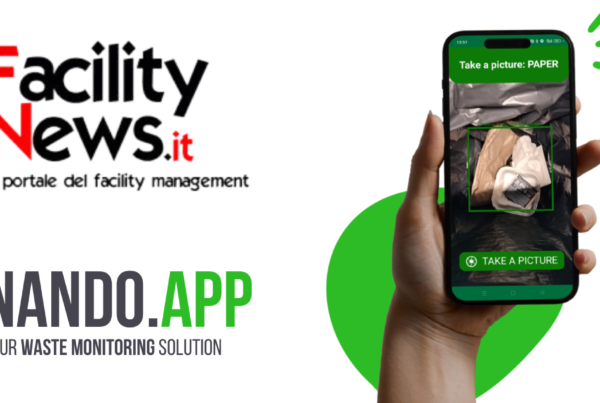
While traditional sensors rely on simple ultrasonic pings, which can be easily fooled by a single cardboard box leaning against the sensor, NANDO.Sensor utilizes advanced image analysis. It doesn’t just “ping” the surface; it identifies what it sees.
- Volume Identification: Precise measurement of how much space remains.
- Weight Calculation: Estimating the payload before the truck even arrives.
- Material Recognition: Identifying the type of waste (plastic, paper, organic).
- Contaminant Detection: Flagging items that shouldn’t be there (e.g., hazardous waste in a recycling bin).
Dynamic routing for urban environments: preventing the “overflow crisis”
In urban contexts, the complexity of waste collection is magnified by traffic congestion, pedestrian safety, and high public visibility. When NANDO.Sensor is applied to urban litter bins, it integrates directly with municipal logistical systems to enable dynamic urban management.
Real-Time vs. Static Planning
In a smart city, the fill rate of bins in a park might triple on a sunny Saturday compared to a rainy Tuesday. A static schedule would miss the overflow on Saturday and waste fuel on Tuesday. NANDO.Sensor monitors these levels in real-time. When a bin reaches a pre-set threshold (e.g., 75%), the system triggers an alert. But it does more than just flag a problem; it optimizes the response.
The AI doesn’t just send a truck to that one bin. It looks at all the bins in the vicinity, analyzes their current levels, and calculates a new, optimized route that addresses the high-priority bin while also picking up other bins that are approaching fullness. This prevents future overflows and maximizes the efficiency of the dispatch.
Reducing urban emissions
By reducing the number of stops and the total distance traveled, cities can significantly lower their logistics-related emissions. This is a critical component of 2026 sustainability mandates. Fewer trucks on the road also means less noise pollution and improved safety for urban residents.
Industrial intelligence: automating the paperwork
For industrial waste management, the challenges are different. Reliability and compliance are the top priorities. NANDO.Sensor serves as an automated auditor for industrial containers.
Automatic Loading and Unloading Registers
Traditionally, operators have to manually record every time a container is filled or emptied. This is prone to human error and takes up valuable time. NANDO.Sensor monitors loads and discharges automatically. It maintains a digital, real-time register of activity, ensuring that the company is always in compliance with environmental regulations without requiring a single minute of manual data entry.
How route optimization saves fuel:
- Eliminates redundant mileage: Fewer backtracking and overlapping routes.
- Reduces idle times: Avoids rush hour zones and stop‑heavy traffic segments.
- Enhances scheduling: Groups stops in the most fuel‑efficient geographical order.
For waste fleets that serve residential and commercial zones daily, these savings multiply rapidly. A 10% reduction in miles driven across a large fleet translates directly into tens of thousands of dollars in annual fuel savings.
The economics of contamination: saving money at the source
One of the most overlooked costs in waste management is contamination. When a recycling container is contaminated with organic waste, the entire load may be rejected at the Material Recovery Facility (MRF), leading to high landfill fees and lost recycling revenue.
Quality over Quantity
Because NANDO.Sensor recognizes the type of waste and detects contaminants, it provides a “Gatekeeper” function. If a sensor detects high levels of contamination, it can alert the manager before the truck arrives.
CO2 Reduction through Quality
Reducing contamination means fewer loads need to be transported multiple times for “re-treatment.” By getting the waste to the right facility the first time, NANDO.Sensor directly lowers the CO2 footprint of the entire waste lifecycle.
Data as the new essential utility
The era of “analog” waste management is coming to an end. The geopolitical and economic realities of 2026 have made the old way of doing business, collecting air and driving blind, a recipe for failure.
NANDO.Sensor is not just a device; it is a gateway to a smarter, more resilient business model. By transforming every bin and container into a connected, intelligent asset, it provides the continuity and reliability of data that modern logistics demands.
Is your fleet ready for the digital transformation?
Don’t wait for the next price spike. See how NANDO.Sensor can optimize your operations today.
See How it Works© 2026 NANDO. Tutti i diritti riservati.