Waste management is one of the most data-poor operational areas in modern facilities. Across the EU, waste generation reached 2,233 million tonnes in 2022, according to Eurostat, with manufacturing accounting for over 10% of the total. Bins are emptied on fixed schedules regardless of fill levels, recycling contamination goes undetected until collection, and sustainability reports are built on estimates rather than verified measurements. For facility managers responsible for both operational efficiency and ESG compliance, this creates real financial and regulatory risk.
Artificial intelligence is changing this. By combining computer vision, IoT sensors, and machine learning, AI waste management platforms give facility teams the real-time visibility they need to reduce costs, improve recycling rates, and produce audit-ready sustainability data automatically.
This guide explains how AI for waste management works, what measurable results organisations have achieved, and how to evaluate a solution that fits your operational environment, whether you manage a corporate office, an industrial plant, a canteen, or a public space.
What Is AI Waste Management?
AI waste management is the application of artificial intelligence technologies, primarily computer vision and machine learning, to automate the monitoring, classification, and reporting of waste across any type of facility or collection network.
Traditional waste management relies on manual inspections and fixed collection timetables. Facility staff have little data on how much waste is being produced, what type it is, or whether it is being sorted correctly. AI waste management platforms replace this guesswork with continuous, automated measurement.
A modern AI waste management system typically covers three core functions:
- Real-time waste monitoring: cameras or sensors detect waste type, volume, and fill levels continuously, without manual input.
- Automated reporting: the system converts raw monitoring data into structured waste reports aligned with sustainability frameworks such as GRI, ISO 14001, or EU CSRD requirements.
- Operational optimisation: collection routes, bin placement, and staff engagement are improved based on actual data rather than assumptions.
The result is a complete, traceable record of waste production and recycling performance across every location, available in a single dashboard.
How AI for Waste Management Works
Understanding the technology behind AI waste management helps facility managers assess what a platform can realistically deliver and how it integrates with existing operations.
1. Data Collection
AI waste management systems gather data through one or more input methods. Camera-based systems use fixed or mobile cameras positioned at waste disposal points, such as bin stations in offices, production lines in factories, or canteen tray returns. Sensor-based systems use ultrasonic or weight sensors placed inside bins to measure fill levels and weight in real time. Hybrid systems combine both, providing both visual classification and volumetric data.
2. AI Recognition and Classification
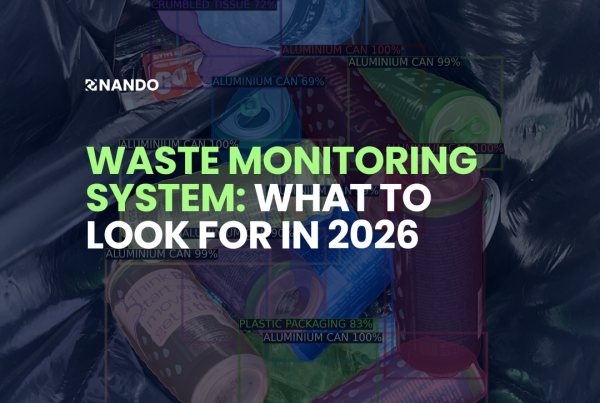
Computer vision models, trained specifically on waste imagery, analyse each image or data stream to identify waste types (paper, plastic, organic, metal, general waste, hazardous), measure volume or weight estimates, and detect contamination in recycling streams. These models are not generic AI tools. Effective waste management platforms train their models on proprietary datasets of waste in real operational environments, which significantly improves accuracy compared to off-the-shelf image recognition systems.
3. Data Processing and Reporting
All measurements are processed on secure infrastructure and made available through a web dashboard. Facility managers can see waste volumes by type, location, and time period. The system automatically generates reports formatted to match GRI standards, corporate ESG templates, or regulatory submissions — eliminating the hours spent compiling data manually at quarter-end.
4. Integration and APIs
Enterprise-grade AI waste management platforms expose API endpoints, allowing waste data to flow into existing ERP systems, sustainability platforms, or facility management software. This makes waste one data stream among many in a broader operational intelligence framework, rather than a standalone silo.
Measurable Benefits of AI Waste Management
The business case for AI waste management is increasingly well-documented. Here are the categories of measurable impact that facility managers consistently report.
Recycling Rate Improvement
Real-time feedback at disposal points, such as screens that confirm whether an item was sorted correctly, drives significant behaviour change among employees and visitors. Organisations deploying AI waste monitoring have reported recycling rate improvements of up to 60% compared to baseline performance before implementation.
Reduction in Collection Costs
Dynamic collection scheduling based on real fill-level data eliminates unnecessary collections. When trucks are dispatched only when bins are actually full, fuel costs, vehicle wear, and labour hours all decrease. For large industrial sites or urban collection networks, this can translate into substantial annual savings.
Avoided CO₂ Emissions
Fewer collection runs, higher recycling rates, and reduced landfill volumes all contribute to measurable CO₂avoidance. Platforms that track this automatically can feed verified emissions data directly into Scope 3 reporting under GHG Protocol frameworks.
Compliance Risk Reduction
For industrial facilities subject to waste tracking regulations, manual data entry creates audit exposure. AI platforms produce timestamped, traceable records of every waste event, significantly reducing the risk of fines or non-compliance findings during inspections.
Reporting Efficiency
Sustainability managers who previously spent several days per quarter assembling waste data from spreadsheets and manual logs report that automated reporting reduces this to minutes. With regulatory requirements under CSRD expanding, this efficiency gain is increasingly strategically important.
How AI Generates Audit-Ready Waste Reporting Automatically
One question facility managers ask most frequently is simple: what does waste reporting actually look like when AI handles it and what formats does the data come out in?
Traditional waste reporting in facilities follows a predictable and painful pattern. At quarter-end, a sustainability manager pulls data from spreadsheets, contractor invoices, weighbridge receipts, and bin collection logs. The data is inconsistent, incomplete, and takes days to reconcile. The final report is built on estimates, not verified measurements, and it shows.
AI waste management platforms replace this entirely. Here is what automated reporting produces in practice:
GRI 306 (Waste) compliance data. Every waste event, disposal, collection, classification, transfer, is timestamped and logged automatically. The system generates structured outputs that map directly to GRI 306 disclosure requirements, including waste generated by type, waste diverted from disposal, and waste directed to disposal by treatment method. No manual compilation required.
ISO 14001 environmental management records. For facilities operating under ISO 14001 certification, AI platforms provide the continuous monitoring records and documented procedures required for audit. Data is traceable to individual collection points and time periods, providing the evidence base auditors need without requiring staff to reconstruct records manually.
CSRD-ready waste metrics. Under the Corporate Sustainability Reporting Directive, companies must report verified environmental data, not estimates. AI waste monitoring produces certified, timestamped measurements that meet the evidential standard required for CSRD disclosure, including Scope 3 emissions data linked to waste treatment and disposal.
EWC code classification. For industrial facilities managing multiple waste streams under different European Waste Catalogue codes, AI recognition systems classify waste by material type and route it to the correct EWC category automatically, generating the transfer documentation required by regulators.
Real-time dashboard with exportable reports. All data is available in a single web dashboard, with exportable reports in standard formats. Sustainability managers can generate a complete quarterly waste report in minutes rather than days, and share it directly with external auditors, ESG rating agencies, or corporate headquarters without further processing.
The practical result: organisations that previously spent 3–5 days per quarter assembling waste data manually report reducing this to under 30 minutes after deploying an AI waste management platform.
Need to see what this looks like for your specific reporting framework? Book a 15-minute demo and we’ll show you a live report from a facility similar to yours.
How to Choose an AI Waste Management Solution
The market for AI waste management is growing, and platforms vary considerably in their technical approach, sector focus, and reporting capabilities. The following criteria should guide evaluation.
Waste Type Coverage
Not all AI waste platforms cover the same waste streams. Confirm that the solution classifies the specific waste categories relevant to your operation, including hazardous, organic, industrial, and recyclable streams, with documented accuracy rates backed by real-world testing, not lab conditions.
Sector Fit
Office waste monitoring, canteen food waste tracking, industrial compliance monitoring, and urban collection optimisation are operationally distinct problems. A platform built specifically for your sector will have pre-trained models, hardware configurations, and reporting templates suited to your environment, rather than requiring significant customisation.
Privacy and Data Security
Camera-based systems must handle privacy compliance carefully. Look for platforms that implement automatic, irreversible anonymisation of faces and identifying information directly on-device, before any data is transmitted to a server. Processing should occur on EU-based infrastructure for GDPR compliance, and the platform should be able to demonstrate its privacy architecture clearly.
Reporting Framework Compatibility
Ensure the platform produces structured outputs compatible with the sustainability frameworks your organisation reports against — GRI, ISO 14001, EU Taxonomy, CSRD, or sector-specific standards. Avoid platforms that only export raw data, leaving your team to interpret and reformat it manually.
Infrastructure Independence
Enterprise deployments benefit from platforms that do not depend on the client’s existing Wi-Fi or IT infrastructure. A dedicated, self-contained connectivity solution reduces deployment complexity and eliminates a common failure point in large or distributed sites.
API and Integration Capability
If waste data needs to connect to ERP systems, ESG platforms, or building management software, confirm the platform offers documented API access with authentication and data export in standard formats. This is essential for scaling beyond a pilot to full site deployment.
Certification and Quality Standards
For regulated industries, confirm that the platform provider holds relevant quality certifications, such as ISO 9001, for the design and implementation of AI solutions. This provides assurance that the data produced will withstand audit scrutiny.
Frequently Asked Questions About AI Waste Management
What types of facilities can use AI waste management?
AI waste management platforms are designed for a wide range of environments. Corporate offices and airports use them to monitor employee recycling and engage staff in sustainability goals. Manufacturing plants and industrial facilities use them for regulatory compliance and hazardous waste tracking. Canteens and food service operations use them to reduce overproduction and food waste. Municipal authorities use them to optimise urban collection routes and detect recycling contamination. The technology is sector-agnostic; the key difference is that the AI models and hardware configurations need to be calibrated for each operational context.
How accurate is AI waste recognition?
Accuracy depends heavily on the training data and deployment conditions. Platforms that train their models on real operational waste data — rather than generic datasets — achieve significantly higher accuracy in production environments. When evaluating a platform, request accuracy benchmarks from deployments in similar facilities, not just controlled laboratory tests. Most enterprise-grade systems achieve recognition accuracy above 90% for major waste categories under normal operating conditions.
Does AI waste monitoring require access to our internal IT systems?
No. Well-designed AI waste management systems operate independently from client IT infrastructure. They use their own secure connectivity rather than the client’s Wi-Fi network, and they do not require integration with internal systems unless the client specifically wants data to flow into existing platforms via API. This makes deployment faster and reduces IT security concerns.
How does AI waste management support ESG and sustainability reporting?
AI waste management platforms collect continuous, verified waste data and automatically structure it into the formats required by major sustainability frameworks — including GRI 306 (Waste), ISO 14001, EU Taxonomy, and CSRD. This eliminates manual data collection, reduces reporting errors, and produces audit-ready documentation that can be shared directly with external auditors or included in annual sustainability reports. For organisations under increasing regulatory pressure to demonstrate verified environmental data, this represents a significant step beyond self-reported estimates.
What is the typical implementation timeline for an AI waste management platform?
Implementation timelines vary by facility size and solution complexity, but most enterprise deployments are operational within weeks rather than months. Camera or sensor hardware installation at waste disposal points typically takes one to two days per site. Software onboarding and dashboard configuration follows, and reporting templates are usually ready for use within the first full month of operation. Platforms that operate independently from client IT infrastructure reduce the coordination time typically required for enterprise software rollouts.
See AI Waste Management in Action
If you are evaluating AI waste management solutions for your facility, the most effective next step is to see real monitoring data from an environment similar to yours. NANDO is an AI waste monitoring platform trusted by over 80 companies across 17 countries, including L’Oréal, Deloitte, and Lavazza to monitor waste in real time, automate GRI reporting, and improve recycling performance.
You can request a personalised demo at NANDO to review a monitoring plan tailored to your site type, waste streams, and reporting requirements.