Geopolitical tensions in the Middle East have pushed crude oil prices above $115 per barrel, dragging up costs across the entire petrochemical supply chain. The result? Producing virgin plastic has suddenly become much more expensive.
Here is how virgin plastic and recycled plastic compare across the metrics that matter most in 2026.
| Virgin plastic | Recycled plastic | |
|---|---|---|
| Raw material | Crude oil / natural gas | Post-consumer or post-industrial waste |
| Price trend (EU 2026) | +30% (oil above $115/bbl) | More stable, less oil-sensitive |
| CO₂ emissions | Baseline | −75% vs virgin |
| Energy consumption | Baseline | −75% vs virgin |
| Oil saved (per tonne) | — | 1.9 tonnes |
| Quality consistency | High, predictable | Variable — depends on sorting quality |
| PPWR compliance | Risk: €0.80/kg levy on non-recycled packaging | Contributes to mandatory recycled content targets |
| CSRD/Scope 3 impact | Higher footprint in supply chain reporting | Lower footprint — measurable advantage |
| Best for | High-spec applications (medical, food contact) | Packaging, industrial components, construction |
Sources: Plastics Europe, Ellen MacArthur Foundation, EU PPWR Regulation, SMX/Yahoo Finance (March 2026), Trading Economics.
April 2026: Oil Above $115 and the Collapse of Virgin Plastic Competitiveness
Here’s what is happening in practice:
Up to +30% price increases for virgin polymers.
Industrial operators across Europe are reporting double-digit increases in plastic material costs within weeks. Polyethylene and polypropylene—the most widely used polymers—track crude oil prices closely, as producing one ton of plastic can require up to 2.2 tons of oil.
The Strait of Hormuz as a global bottleneck.
Around 20% of the world’s crude oil passes through this chokepoint. The Iranian crisis has turned it into an unsustainable insurance risk, with logistics costs for exporting plastic and paper to Asia rising by 40% in just three weeks. Entire recycling trade routes have been disrupted.
Gas above €45/MWh ($47–$49/MWh)
Plastic recycling is energy-intensive. In recent months, rising gas prices have further increased operating costs for Italian plants, squeezing recyclers’ margins.
Is Recycling Becoming Profitable Again?
The slowdown in recycling seen in recent months, driven by the low competitiveness of recycled materials, has eased due to the Iran crisis. As virgin plastic prices rise, recycled plastic is becoming attractive again.
In other words: the recycled plastic market is structurally tied to oil prices. When crude rises enough, secondary raw materials become competitive again. But this is only half good news.
The structural issue remains: relying on oil price fluctuations to determine whether recycling is viable is a fragile strategy, for both recyclers and manufacturing companies. Every time oil prices fall, virgin plastic imported from China and Southeast Asia floods the European market at prices that are impossible to match for companies operating under Western environmental and labor standards.
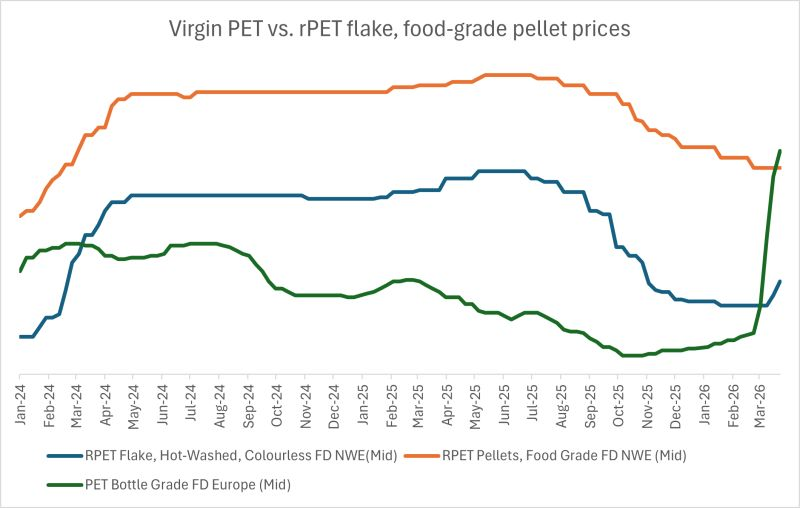
Source: ICIS
The Numbers Companies Need to Know
Regardless of short-term market dynamics, the environmental impact data for recycled plastic remains clear:
- –75% CO₂ emissions compared to virgin plastic
- –75% energy consumption in the production process
- For every ton of recycled plastic:
- 1.9 tons of oil saved
- 3,000 kWh of electricity saved
These figures are not just about environmental sustainability. In a context where companies are required to report their emissions—with increasingly strict ESG and CSRD obligations—the type of plastic used directly impacts Scope 3 calculations and GRI reporting.
The European Union is moving in the same direction. The new PPWR (Packaging and Packaging Waste Regulation), effective from August 2026, expands the scope of accountable packaging and sets increasingly ambitious targets for minimum recycled content.
Companies that fail to comply already risk paying the European plastic levy of €0.80/kg on non-recycled plastic packaging. In 2024 alone, Italy paid approximately €751 million under this mechanism.
The Role of AI in Maximizing the Value of Recycled Plastic
In this scenario, the real competitive variable is no longer just choosing between virgin and recycled plastic—it is knowing exactly how much plastic is generated, where, of what quality, and how it is managed.
This is where technology comes in.
NANDO is an AI-powered waste monitoring platform that helps companies across industries, from manufacturing to offices, logistics, and retail gain full, real-time visibility over their waste streams, including plastic.
How does it work in practice?
Real-time AI monitoring of plastic waste.
NANDO uses computer vision and machine learning algorithms specifically trained to recognize and measure waste. This means companies know every day, in every location, how much plastic is generated, what type it is, and whether it ends up in the correct recycling stream.
Automated ESG and GRI reporting.
In a context where waste data must be certified, traceable, and audit-ready, NANDO automatically converts monitoring data into structured reports. No more manual estimates, only accurate data to support sustainability disclosures.
Optimization of waste sorting flows.
Better separation at source leads to higher-quality materials, making recycling more efficient and increasing the market value of secondary raw materials. NANDO can improve recycling rates by up to 60%, directly reducing disposal costs and increasing recovered material value.
Regulatory compliance without risk.
With PPWR and CSRD coming into force, companies unable to demonstrate their waste performance face legal and reputational risks. NANDO provides the certified data needed to avoid them.
What Companies Should Do Now
The 2026 oil crisis is a temporary opportunity to reassess recycled plastic. But forward-thinking companies do not wait for the market to force change, they build internal systems that make recycling viable regardless of oil price fluctuations.
Three concrete steps:
Measure.
You can’t improve what you don’t measure. Knowing how much plastic you generate and how it is managed is the essential starting point.
Sort correctly.
Accurate waste separation at source increases the quality and value of recycled materials. AI technology enables this at industrial scale.
Report.
Certified waste data is not just a regulatory requirement—it is a reputational asset and a competitive advantage in tenders and ESG evaluations.
Oil Prices rise and fall, but data remains
The plastic market is inherently cyclical. The Iran crisis has temporarily reshaped the balance between virgin and recycled plastic, but it has not solved the structural problem: the circular economy cannot depend on oil price volatility.
Companies that want to break out of this cycle need reliable, automated, and certified data on their waste.
That’s exactly what NANDO does: transforming waste from a problem into a measurable, manageable, and reportable resource.
Make Your Waste Management Smart and Efficient
Discover how NANDO can help your company optimize plastic waste management.
Book a Free Demo