How Dussmann Reduced Canteen Food Waste by 60% with AI — Case Study
Dussmann Service cut food overproduction waste from 20% to 6–8% in a corporate canteen in Rome using NANDO.Canteen AI cameras. Here is how AI-powered food waste monitoring transformed their meal service, and what it means for any food service operation in 2026.
Key results at a glance
| Metric | Result |
|---|---|
| Food overproduction waste | –60% reduction |
| Uneaten food rate | 20% → 6–8% |
| Recycling accuracy improvement | +60% in 2 months |
| Data categories monitored | 21 food categories |
The Challenge: Food Waste Without Visibility
Corporate canteens face a structural problem: food is produced based on estimates, not data. When those estimates are wrong, which they frequently are, the result is systematic overproduction, food waste, and avoidable costs.
Dussmann Service, one of Europe’s leading facility management companies, faced this challenge in their corporate catering operations. Without real-time visibility into what diners were actually eating versus leaving on their trays, kitchen staff had no reliable basis for adjusting portions or menus.
The consequences were measurable: high food waste rates, elevated food costs, and an ESG gap in sustainability reporting.
The Solution: NANDO.Canteen AI Food Waste Monitoring
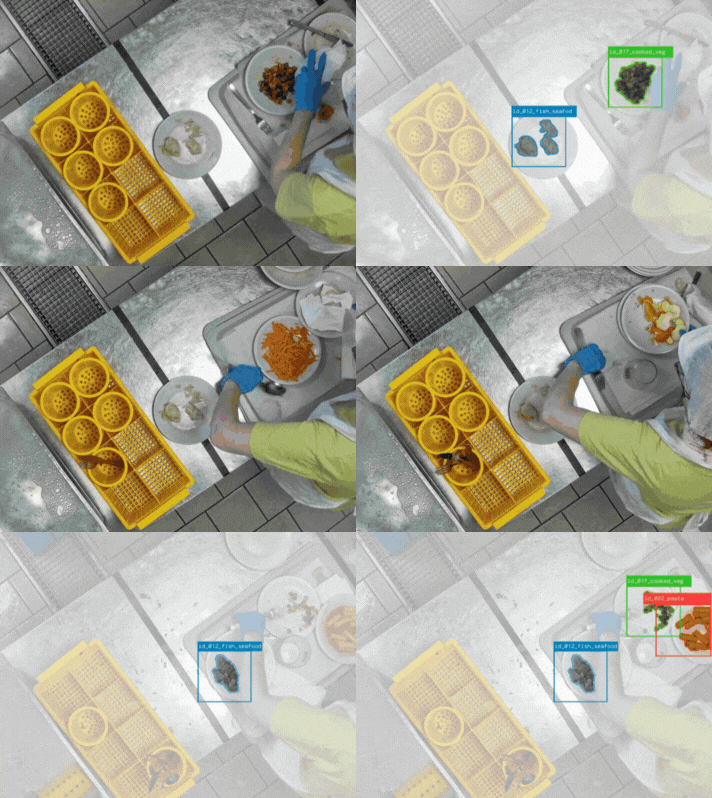
Dussmann implemented NANDO.Canteen in a corporate canteen in Rome. Two AI cameras were installed strategically at the tray return area, the point where uneaten food becomes waste data.
How NANDO.Canteen Works
-
-
- Automatic detection: Cameras recognize food residues across 21 categories (pasta, meat, vegetables, fruit, bread, etc.)
-
- Weight estimation: Advanced algorithms calculate the precise quantity of food wasted per tray
-
- Real-time dashboard: Data aggregated and visible immediately to kitchen staff
-
- Weekly reports: Actionable insights for menu and portion optimization
- KPI monitoring: Continuous tracking of waste evolution over time
-
The system requires no changes to kitchen workflows or diner behavior — it operates passively, turning every returned tray into a data point.
Results: From Gut Feel to Data-Driven Decisions
Food waste reduction
Within months of deployment, overproduction waste dropped from 20% to 6–8% — a reduction of more than 60%. Kitchen staff could now identify with precision which dishes were consistently left uneaten, and adjust production quantities accordingly.
Recycling quality improvement
Alongside food waste reduction, NANDO.Canteen’s monitoring contributed to a 60% improvement in recycling accuracy within the canteen in just two months — a direct result of better visibility into waste streams.
Menu optimization
By analyzing real consumption data — what was actually eaten versus what was left — Dussmann was able to:
-
-
- Eliminate dishes that were systematically unpopular
-
- Increase frequency of highest-rated meals
-
- Test new recipes with immediate feedback from consumption data
-
- Adjust portion sizes to match actual diner preferences
- Personalize menus across different corporate locations
-
Economic and environmental impact
Cost savings
Reducing food overproduction waste by 60% translates directly into lower food costs. Less raw material is purchased, less staff time is spent on excess preparation, and less waste requires disposal.
ESG and sustainability reporting
Every kilogram of food saved with NANDO.Canteen represents less water, energy, and natural resources consumed in food production — and lower CO₂ emissions from both production and organic waste disposal. This data feeds directly into ESG sustainability reports.
As Alessio Vismara, COO of Dussmann’s Business & Industry division, noted:
the system allows analytical, accurate monitoring of perceived quality within their corporate restaurants. improving service and better satisfying client preferences.
Circular economy integration
The food waste data generated by NANDO.Canteen also opens pathways for surplus food recovery programs and circular economy certifications, increasingly relevant for corporate sustainability strategies under CSRD.
Why this model is scalable
The Dussmann implementation demonstrates that AI-powered food waste monitoring is not limited to large corporate canteens. The same approach applies to:
-
-
- Hospital and healthcare catering — where dietary requirements make overproduction particularly costly
-
- University and school canteens — high volume, variable attendance, significant waste potential
-
- Airport and transport hub food service — unpredictable demand patterns where data is especially valuable
- Commercial restaurant groups — multi-location operations needing centralized waste visibility
-
NANDO.Canteen deploys in under 48 hours per location, requires no structural changes, and begins generating actionable data from day one.
Frequently Asked Questions
How does AI reduce food waste in corporate canteens? NANDO.Canteen uses cameras at the tray return area to identify and weigh uneaten food across 21 categories in real time. This data allows kitchen managers to adjust portions and menus based on actual consumption patterns rather than estimates.
How quickly does NANDO.Canteenshow results? Dussmann saw measurable waste reduction within the first weeks of deployment. Overproduction waste dropped from 20% to 6–8% within months, and recycling accuracy improved by 60% in the first two months.
Does NANDO.Canteen require changes to canteen layout or workflow? No. The system uses cameras installed above the tray return area. No structural changes, additional hardware at table level, or modifications to kitchen or service workflows are required.
Can food waste monitoring data be used for ESG reporting? Yes. NANDO.Canteen generates certified food waste data compatible with CSRD, GRI, and corporate ESG frameworks. Data is automatically aggregated and exportable for sustainability reports and audits.
Is NANDO.Canteen suitable for high-volume food service environments? Yes. NANDO.Canteen is designed for high-volume operations including corporate canteens, hospital catering, university cafeterias, and large-scale food service. It operates in real time without slowing service or requiring workflow changes.
Ready to Reduce Food Waste in Your Canteen?
Discover how NANDO.Canteen can help you monitor, analyze and reduce food waste with AI technology, just like Dussmann did.
Related pages: NANDO.Canteen · Food Waste Industry · Case Studies