Cities lack accurate data on the volume and weight of waste produced. Without this information, trucks follow fixed routes and collect half-empty bins while full ones overflow.

NANDO.Sentinel leverages AI and cameras to optimize urban waste collection, reduce emissions and monitor city areas with low quality.
Trusted by +80 clients











![Logo [Eni Versalis] cliente NANDO](https://nandoai.com/wp-content/uploads/2026/02/ENI-VERSALIS.png "ENI VERSALIS")
![Logo [Ericsson] cliente NANDO](https://nandoai.com/wp-content/uploads/2026/02/ERICSSO.png "ERICSSO")
![Logo [Franke] cliente NANDO](https://nandoai.com/wp-content/uploads/2026/02/FRANKE.png "FRANKE")
![Logo [LUISS] cliente NANDO](https://nandoai.com/wp-content/uploads/2026/02/LUISS.png "LUISS")
![Logo [Philip Morris] cliente NANDO](https://nandoai.com/wp-content/uploads/2026/02/PMI.png "PMI")
![Logo [Sodexo] cliente NANDO](https://nandoai.com/wp-content/uploads/2026/02/SODEXO.png "SODEXO")
![Logo [CBRE] cliente NANDO](https://nandoai.com/wp-content/uploads/2026/02/CBRE.png "CBRE")
![Logo [Narita Airport] cliente NANDO](https://nandoai.com/wp-content/uploads/2026/02/Loghi_clienti_sitoweb-2-1.png "Loghi_clienti_sitoweb (2)")
















![Logo [Leonardo] cliente NANDO](https://nandoai.com/wp-content/uploads/2026/02/Loghi_clienti_sitoweb.png "Leonardo_logo")
![Logo [Schnider Electrics] cliente NANDO](https://nandoai.com/wp-content/uploads/2026/02/Loghi_clienti_sitoweb-2.png "schnider electrics")

![Logo [Cirfood] cliente NANDO](https://nandoai.com/wp-content/uploads/2026/02/CIRFOOD.png "CIRFOOD")



what problem does it solve?
From garbage trucks to smart sentinels.
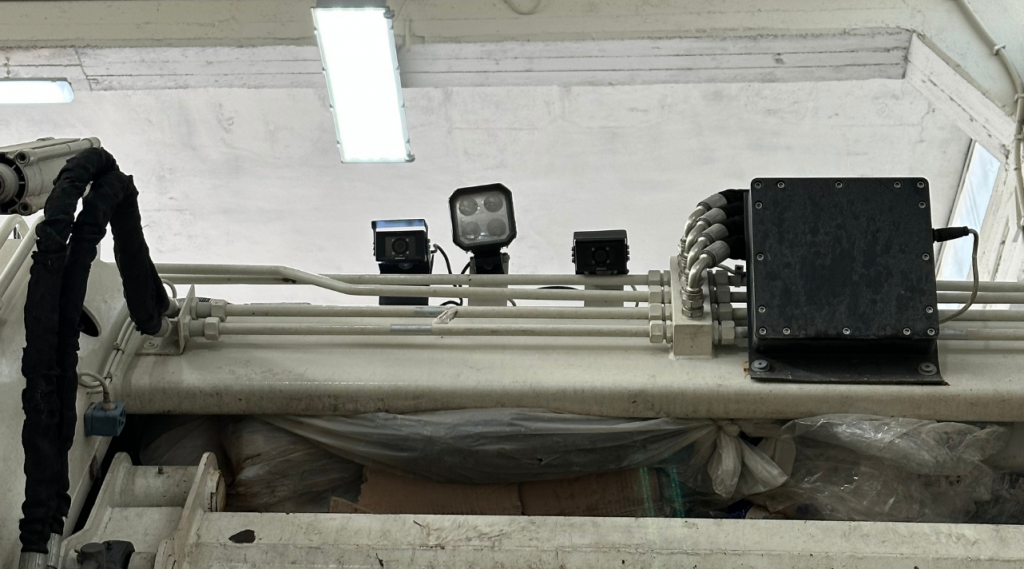
NANDO.Sentinel is an innovative solution that turns waste collection trucks into intelligent mobile sensors. Equipped with AI cameras mounted on the vehicles, the system detects in real time the quantity and quality of waste, as well as illegal dumping, without the need for manual inspections.
Without continuous monitoring of waste composition and contamination levels, operators cannot identify underperforming areas or intervene promptly with targeted communication actions to improve collection quality.
how it works
NANDO.Sentinel installs on any existing sentinel truck. No electrical connection, no structural modifications, no downtime. Industrial-grade hardware built for harsh environments with IP67 rating and ATEX certification for hazardous zones.

Detect contamination by truck container, score quality by zone, and track merceological patterns over time. Perfect for targeting citizen education campaigns and improving recycling rates citywide.

NANDO’s centralized dashboard delivers real-time monitoring of waste quantity, material quality, and illegal dumping events at citywide scale.
Data is aggregated by location, district, and user category, enabling performance benchmarking, contamination tracking, and targeted operational optimization.
REAL IMPACT
Book a demo
Join the organizations using NANDO.Sentinel to transform traditional waste collection into a data-driven urban service. Reduce emissions, optimize costs, and gain total visibility over your city.
Got a question? We’ve got you covered.
NANDO.Sentinel is a solution that uses artificial intelligence and cameras mounted on waste collection vehicles to transform garbage trucks into true “intelligent sentinels.” It monitors in real-time the quality and volumes of waste in cities, helps reduce emissions, and optimizes routes and collection operations for urban authorities and waste management companies.
The main advantages include identifying the most critical users in terms of quality of separated waste fractions, alerting citizens to the most frequent disposal errors, and enabling more effective strategic communication aimed at increasing collection quality according to the “measure – educate – measure” logic. Through volume data, it’s possible to lay the groundwork for potential pay-as-you-throw tariff models in door-to-door collection systems. In street collection models, NANDO.Sentinel uses historical volume data recorded during emptying to predict future volumes and optimize emptying frequencies.
Yes, NANDO.Sentinel works with both collection methods, but the advantages differ slightly. In door-to-door collection, the system monitors the quality and volumes of each individual user to provide a concrete basis both for better communication with citizens (communicating errors detected in bins or containers) and for pay-as-you-throw tariff based on measured volumes. In the street model, NANDO.Sentinel identifies the most critical containers in terms of quality (as in the door-to-door model), but also suggests emptying frequency based on actually measured volumes and identifies illegal dumping near containers.
No, installation can be performed by the NANDO team, the waste management company’s workshop, or the vehicle outfitter and involves installing three components: 1) a Mobile Data Recorder (MDR) inside the cabin, 2) a video camera on the hopper where waste is deposited, and 3) a cable connecting the MDR to the camera. All components will be provided pre-configured by the NANDO team. A NANDO team member will be present during installation to supervise and perform final assembly functional tests. Installation time on a vehicle already in use is approximately 3-4 hours.
Yes, the system can be installed on any vehicle model (rear loader, side loader and dual side loader, top loader, vehicles with fixed or removable compactor, porter with compactor, etc.).

info@nandoai.com
© 2026 NANDO powered by Re Learn SRL
| P.IVA: 12428410018